
Carlos was deported to Mexico for a crime he didn’t commit. Will he ever see his loved ones again?
immigrant



American Tragedy: The Deportation of G.I. Jose (toon)
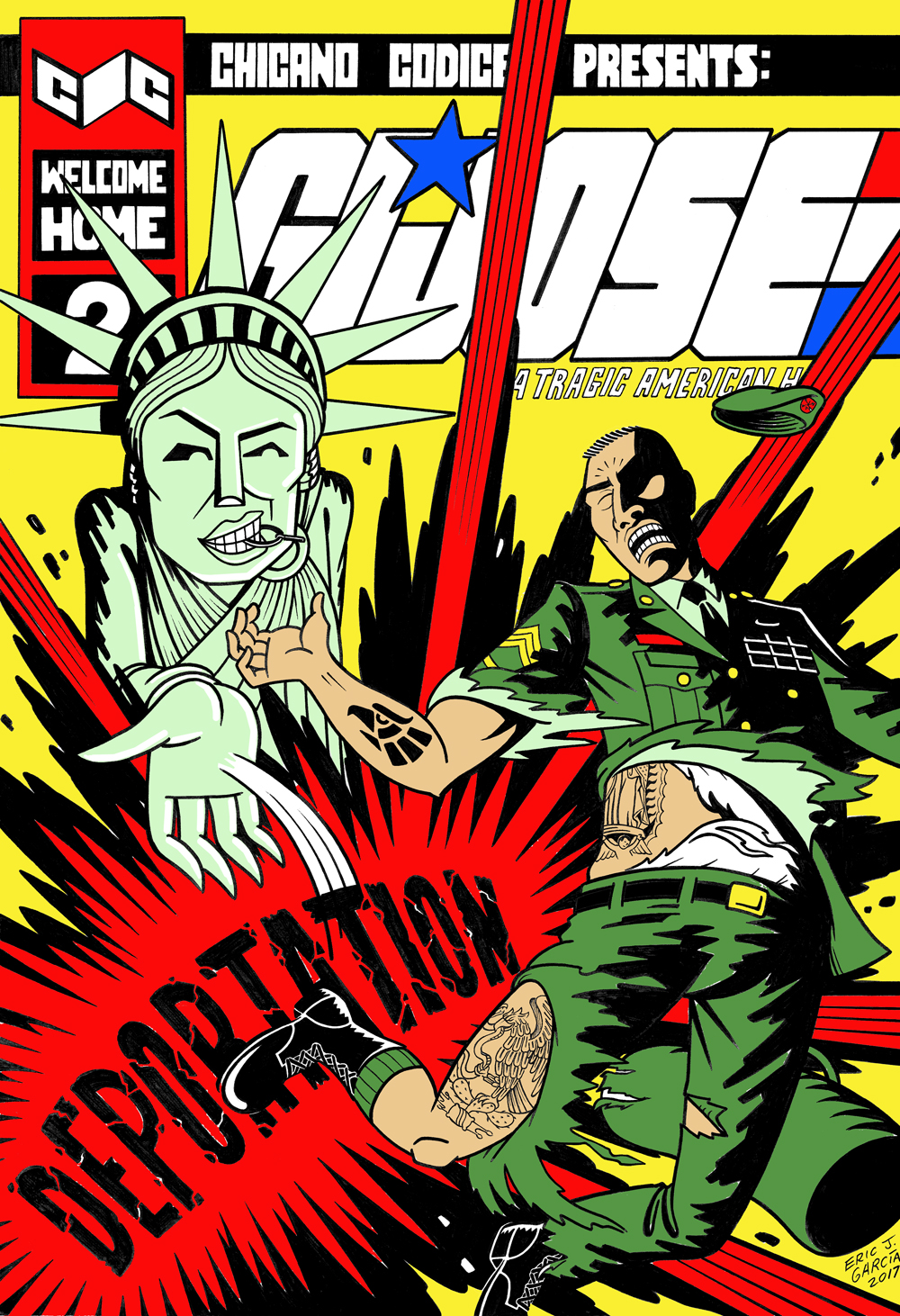
[More about deported veterans at PBS News Hour….]
The truck that feeds New York City: Sidewalk Tacos (video)
The folks who work at Sidewalk Tacos feed the people of New York City, but they have LA MIGRA on their minds. [Video by Elliot Levy, a Belgian living in New Ork.]

Tom Russell live music video: “Who’s gonna build your wall?”
Singer songwriter Tom Russell — he comes from border country in Texas — has a question for the Cheeto Bandido: “Who’s gonna build you wall?”




Oral History: ‘I came to the U.S.A. in 1962 as a bracero’ (videos)
When labor was short in 1950s and 60s, the American and Mexican governments worked together to import laborers across the border to work as “braceros.”
The American Friends service Committee explains:
Mas…Oral History: ‘I came to the U.S.A. in 1962 as a bracero’ (videos)

When stopped by La Migra, KNOW YOUR RIGHTS! (photo)

[Public domain photo by Customs and U.S. Border Patrol.]
Donald Trump to Mexico: This is a Declaration of Wall! (toon)

[Max Espinoza toons for the BabyLonBros.]
LatinoUSA NPR Audio: The 1% and 99% of Mexico meet in NYC
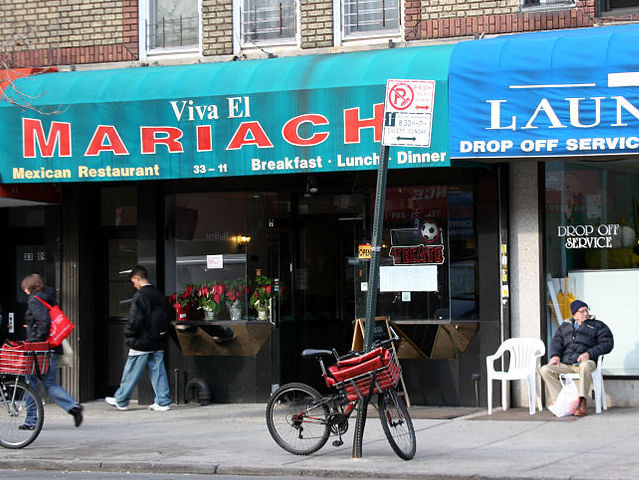
LatinoUSA’s Antonia Cereijido writes the intro:
If you go to a high-end restaurant in New York City, there’s a good chance that you’re dining among some of the wealthiest Mexicans in the world and being served by some of the poorest. This story was produced in collaboration with Round Earth Media. Tyler Kelley is a co-reporter on the piece.
[Mariachi Restaurant in Astoria, Queens, NY, photographed by Aude. Some rights reserved.]
Mexico fears Trump means deportations, end of remittances (video)
As the inauguration of Donald Trump gets closer, our friends and families south of the border are getting increasingly concerned.
Mas…Mexico fears Trump means deportations, end of remittances (video)



Vote! Damian Lopez Rodriguez died to become a citizen (video)
Damian Lopez Rodriguez was brought to the USA without documents as a child — you know, one of those rapists and narcos from Mexico Donald Trump is going to deport.
Damian loved his new country so much he enlisted in the Army when he turned 18. After he died in Iraq, he was granted posthumous citizenship by President George Bush. Damian’s dad has faith his son in Heaven is voting in this election. Are you?
Play by play from East LA: ‘Undocumented Football’ (poetry video)
Today is the big game — Roosevelt vs Garfield — the Boyle Heights East/Los Angeles high school football rivalry that has lasted generations. The Roughriders meet the Bulldogs this evening at Weingart Stadium on Avenida César Chávez in Monterey Park.
In this 2013 poetry video, David A. Romero supplied the play by play.
In South Philly, immigrant restauranteurs worry about Trump (videos)
Donald Trump’s racist anti-immigrant rhetoric is a big worry for immigrant-owned businesses. The owners of a South Philadelphia staple, South Philly Barbacoa — around the corner from the famed Italian street market — are concerned about what a victory by GOP haters might mean for their family. [Video by Cora Cervantes.]
Mas…In South Philly, immigrant restauranteurs worry about Trump (videos)
Happy Rosh HaShana from the Jews of Tijuana! Happy 5777! (video)
 Mexico, like the United Estates, is a “nation of immigrants.”
In the 1900s, Tijuana welcomed Jewish refugees fleeing wars, hate and poverty in Europe, Asia and the Mideast.
Tijuana Jews, the story of the extended Artenstein family, has become a POCHO Rosh HaShana (New Year) tradition ever since we noticed rosh-ha-shana rhymed with Tijuana in 2012.
Mas…Happy Rosh HaShana from the Jews of Tijuana! Happy 5777! (video)
Brooklyn loves this taquero, and he loves Brooklyn back (video)
A Mexican immigrant brings a taco truck to Brooklyn, helps the neighborhood, has fun, and makes money. It’s the American Dream!
From Michoacan to LA: ‘Chef Al Pastor’ and his American Dream (video)
 His father wanted him to stay in Michoacan, work on the family farm, and do construction, but Raul Morales crossed over from Mexico at 17 to pursue his culinary dreams. Now, at 44, he’s his own boss, and a master of tacos al pastor. “Chef Al Pastor” was interviewed at his Los Angeles restaurant Taqueria Vista Hermosa.



Alvaro Huerta, Ph.D: The day my Mexican father met Cesar Chavez
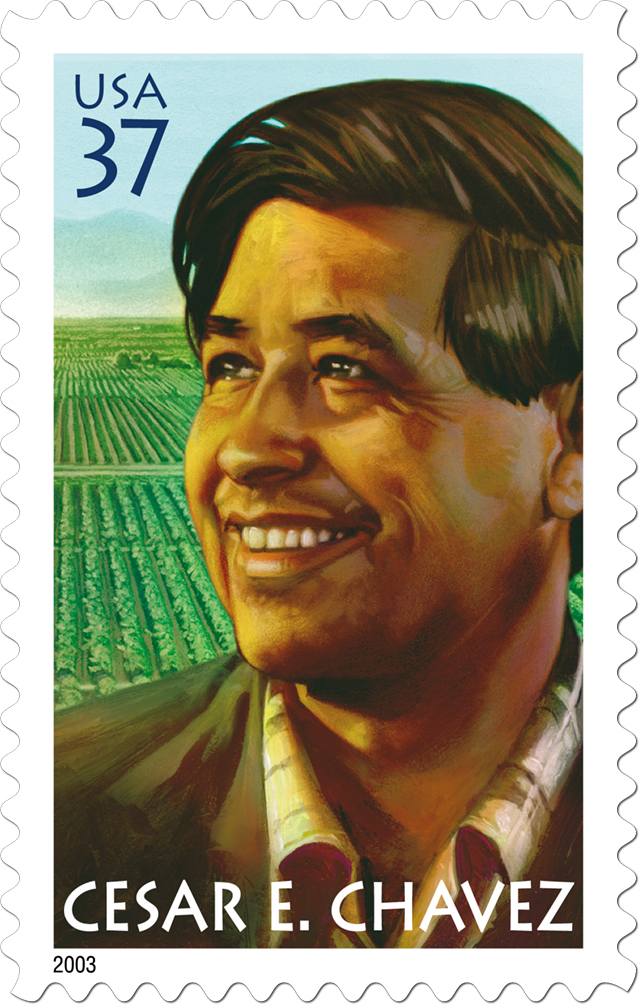
Long live the farmworkers!
My late father, Salomón Chavez Huerta, first arrived in this country as an agricultural guest worker in the mid-1900s, during the Bracero Program. The Bracero Program represented a guest worker program between the United States and Mexico. From 1942 to 1964, the Mexican government exported an estimated 4.6 million Mexicans to meet this country’s labor shortage not only in the agricultural fields during two major wars (WWII and Korean War), but also in the railroad and mining sectors.
Like many braceros of his generation from rural Mexico, my father didn’t speak too much about the horrible working / housing conditions he endured while toiling in el norte. This included low pay, overcrowded housing, terrible food, limited legal rights, lack of freedom outside of the labor camps, racism, verbal / physical abuse and price gauging from company landlords / stores.
Mas…Alvaro Huerta, Ph.D: The day my Mexican father met Cesar Chavez
CNN video: ‘Remittances’ from the U.S. keep this Mexican town alive
After a son leaves his small, impoverished Mexican town of Francisco Villa to find a better life in Chicago, he sends money to help his family — and hometown — alive. Racist Donald Trump says he would stop these “remittances.”
You can’t deport me! I’m Scotch-Irish, like President Obama! (toon)
 Herr Trump can’t deport me! I’m of Scotch-Irish descent, just like President Obama. Here is my official CLAN POCHO tartan if you don’t believe me.
Watch: Pregnant mujer crossing border gives birth to ‘Alien’
Locked in the back of a van, desperate migrants must cross the Mexican border into the U.S. before one of them gives birth to an illegal alien. The Birth of an Alien (El Nacimiento de un Extranjero) is from Sumiko Braun.